Predicting HER2 status from histopathology slides with attention-driven deep learning
An exploratory weakly supervised pipeline that predicts slide-level HER2 status from histopathology images using attention-based multiple-instance learning.
best reported test AUC
The analytical sample and class counts remain incompletely documented; no external clinical validation.The one-minute brief
HER2 status guides breast-cancer treatment but standard testing requires specialised laboratory workflows. This work explored whether morphology in digitised tissue images contains a learnable, interpretable signal. It does not propose replacing IHC or FISH.
Can weakly supervised attention-based multiple-instance learning recover a useful and interpretable signal for HER2 status from whole-slide histopathology images?
An AUC of 0.574 indicates limited discrimination, only modestly above chance. The study is valuable as an interpretable feasibility experiment and a foundation for better controlled work, not as evidence of clinical utility.
Author-supplied completed preprint; not peer reviewed and not evidence for clinical use. The manuscript discloses OpenAI ChatGPT and Google Gemini use for language refinement and grammatical review; the authors state that they independently produced and verified the scientific content, analysis, interpretations, and final manuscript.
Methods
Attention MIL · whole-slide pathology
- 01
Used the HER2 Tumor ROIs v3 collection from The Cancer Imaging Archive, with reference status confirmed by IHC and FISH.
- 02
Applied U-Net tissue segmentation, Macenko stain normalisation, and non-overlapping 512 × 512-pixel patch extraction at 20× magnification.
- 03
Compared ResNet-50 and EfficientNet-B0 feature extractors with mean and attention-based MIL aggregation using a shared patient-level split; reported 95% confidence intervals and paired DeLong comparisons.
Reported findings
The highest point estimate, attention-based EfficientNet-B0, achieved AUC 0.5740 (95% CI 0.4770–0.6917); the interval included 0.5.
Attention did not significantly improve discrimination over mean aggregation (EfficientNet-B0 DeLong p=0.984; ResNet-50 p=0.991), but produced spatial maps for inspecting model focus.
An AUC of 0.574 indicates limited discrimination, only modestly above chance. The study is valuable as an interpretable feasibility experiment and a foundation for better controlled work, not as evidence of clinical utility.
Figures from the source report
These are selected directly from the supplied source documents and captioned to aid interpretation. They are not decorative or newly generated.
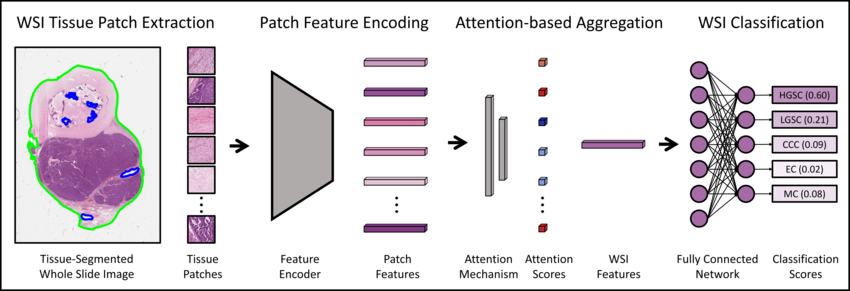
Figure 1 from the completed preprint: the end-to-end workflow for tissue selection, patch extraction, feature encoding, attention aggregation, and slide-level HER2 prediction.
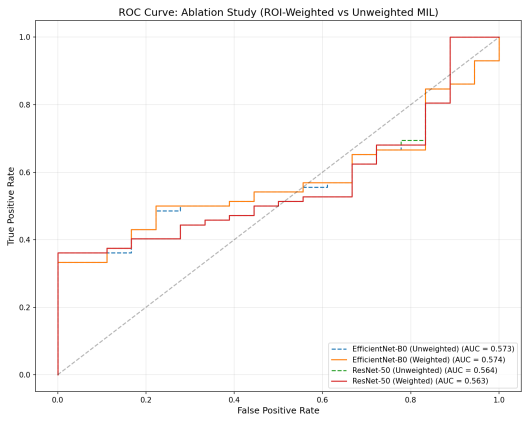
Figure 2 from the completed preprint. All four ROC curves remain close to the no-discrimination diagonal (AUC 0.5632–0.5740), supporting the conclusion that clinically useful prediction was not demonstrated.
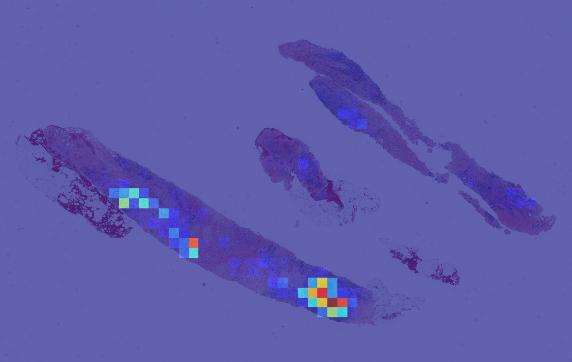
Figure 3 from the completed preprint. Warmer colors indicate larger learned attention weights. They show model weighting, not confirmed pathological importance or causal explanation.
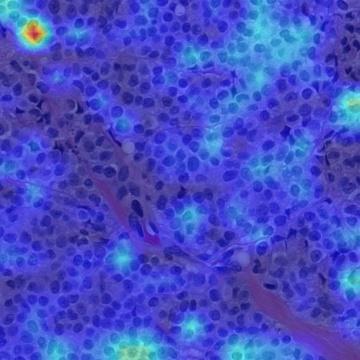
Figure 4 from the completed preprint: an example patch-level Grad-CAM view. It is a model-behavior visualization and was not validated against expert annotation.
Limitations
The boundary of the claim is part of the result—not a footnote.
- 01
The completed preprint states that the final analytical sample, class distribution, exclusion process, and patient–slide mapping remain absent from the source report.
- 02
Performance is insufficient for clinical decision support, screening, or treatment selection.
- 03
Attention visualisation indicates model focus but does not establish causal pathological relevance.
- 04
Independent external and prospective validation remain necessary.
Contributors & governance
Authors
- Thanakorn BuathongtanakarnSuankularb Wittayalai School
- Poonyapart SirithipvanichSuankularb Wittayalai School
- Taweerungson PanudachtipSuankularb Wittayalai School
Advisers
- Phopnipit SingpruSuankularb Wittayalai School
- Chorawit PromchanSuankularb Wittayalai School
Role
Thanakorn is listed as one of three developers. The supplied report does not provide a formal individual contribution taxonomy.
Data
The analysis used a public TCIA research collection. No whole-slide images or patient-level records are redistributed by this website.
Ethics
The project used a public de-identified research collection. Readers should consult the dataset documentation for its original consent and governance conditions.
Competing interests
No competing interests are stated in the supplied report.
Funding
- National Science and Technology Development Agency (NSTDA)
- National Research Council of Thailand (NRCT)
Read & cite
Buathongtanakarn T, Sirithipvanich P, Panudachtip T. Predicting HER2 Status in Breast Cancer Using Attention-Driven Deep Learning on Histopathology Whole-Slide Images. Preprint; 2026. Project 28YMDC01620T.