Bone-abnormality detection in radiographs using YOLOv7
A student research project that trained a YOLOv7 object detector on paediatric wrist radiographs to explore automated localisation of bone abnormalities.
reported mAP@0.5
No external or prospective clinical validation; two reported metrics require clarification.The one-minute brief
Radiograph interpretation is time-sensitive and specialist capacity is uneven. This project tested whether an object detector could localise abnormalities in a public teaching dataset. It was an engineering feasibility study, not a clinical evaluation.
Can a YOLOv7 model detect and localise abnormalities in hand and forearm radiographs with useful experimental performance and sub-second inference?
The work demonstrates an end-to-end learning exercise in medical-image detection. Its reported metrics should be read as results from a school project, not evidence of diagnostic accuracy, safety, or clinical utility.
Educational research only. The model is not a medical device and has not been validated for clinical use.
Methods
YOLOv7 · retrospective image dataset
- 01
Used the public GRAZPEDWRI-DX paediatric wrist radiograph dataset and its annotations.
- 02
Prepared training, validation, and test partitions and trained a transfer-learning YOLOv7 pipeline in Python and PyTorch.
- 03
Reported object-detection performance with mean average precision, precision, recall, F1 score, loss, and inference time.
Reported findings
The report states mAP 87.5%, precision 85.4%, and recall 82.7%.
The report also states F1 0.22 and minimum inference time 0.001 ms; these values are not internally consistent with the other reported metrics and were not independently re-computed for this website.
The work demonstrates an end-to-end learning exercise in medical-image detection. Its reported metrics should be read as results from a school project, not evidence of diagnostic accuracy, safety, or clinical utility.
Figures from the source report
These are selected directly from the supplied source documents and captioned to aid interpretation. They are not decorative or newly generated.
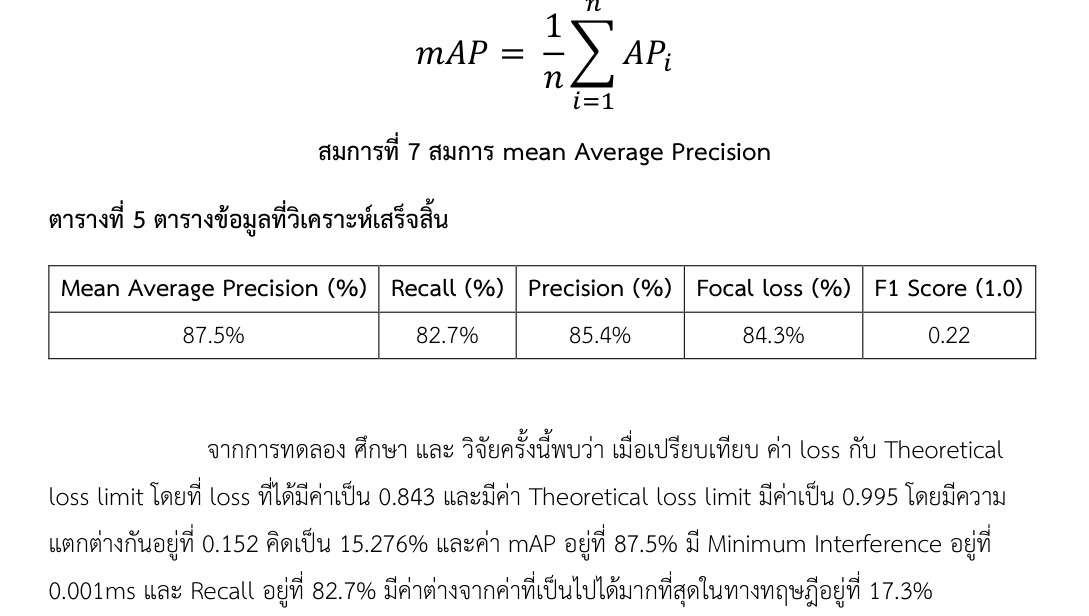
Reported evaluation table from the submitted report. The mAP, recall, and precision values are reproduced as written; the focal-loss percentage and F1 value appear internally inconsistent and should be independently verified.
Limitations
The boundary of the claim is part of the result—not a footnote.
- 01
No external or prospective clinical validation was reported.
- 02
The report does not fully document patient-level splitting, confidence intervals, or class-level error analysis.
- 03
The metric table contains inconsistencies, and the stated inference time requires revalidation.
- 04
The system must not be used for diagnosis, triage, or treatment decisions.
Contributors & governance
Authors
- Jira PurintharapibalSuankularb Wittayalai School
- Yanapat BamrungsinSuankularb Wittayalai School
- Tharit RueangsangSuankularb Wittayalai School
- Thanakorn BuathongtanakarnSuankularb Wittayalai School
Advisers
- Manika SaenjanthaSuankularb Wittayalai School
Role
Thanakorn is listed as one of four student researchers. The supplied report does not specify individual CRediT-style contributions, so no narrower contribution is claimed here.
Data
The project used GRAZPEDWRI-DX, a public research dataset. No patient-level data are hosted on this website.
Ethics
The supplied student report does not state a separate institutional ethics approval. This website presents aggregate project information only.
Competing interests
No conflict-of-interest statement appears in the supplied report.
Read & cite
Purintharapibal J, Bamrungsin Y, Rueangsang T, Buathongtanakarn T. Bone-abnormality detection in radiographs using YOLOv7. Suankularb Wittayalai School; 2024.